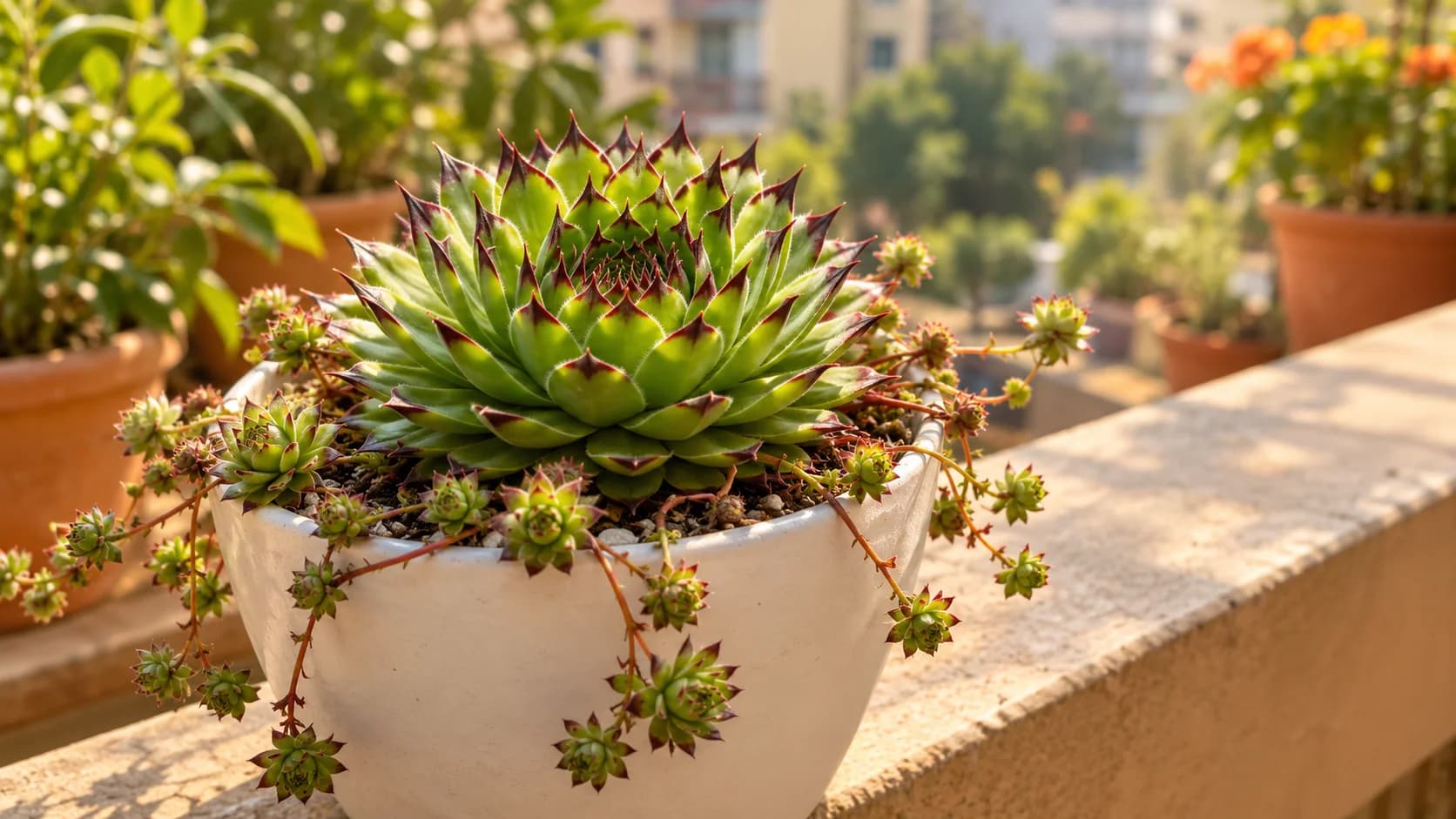
Here's a myth worth clearing up first: "Laxmi Kamal" is not one specific plant. It's a trade name, and Indian nurseries stick it on a few different rosette succulents that all resemble a lotus. So if you searched for a Laxmi Kamal plant and followed the first care guide you found, there's a fair chance you've been looking after the wrong species.
Most guides skip that. They also skip the part that matters more for Indian growers. The classic Laxmi Kamal is a mountain plant. A Kolkata monsoon or a humid Chennai July is not what it was built for.
What is a Laxmi Kamal plant, really?
Laxmi Kamal is the Indian trade name for rosette-forming succulents that resemble a lotus. Usually it's Sempervivum tectorum or a close Sempervivum hybrid, known abroad as hens and chicks. But some nurseries label Echeveria lookalikes with the same name, so check the leaf tips and offsets before you trust the tag.
The name means Goddess Lakshmi's lotus, and you can see why once you look down on a tight, layered rosette. The genus name Sempervivum comes from Latin words for "always living". That's a fair hint at its personality in cool weather. Sellers list hybrids under names like 'Green Wheel' and 'Orange Frost', and you'll even find online guides quoting a completely different species name for it.
Two mix-ups come up constantly. Brahma Kamal is another thing altogether: a Himalayan flowering plant (Saussurea obvallata) that grows at high altitude and isn't a succulent at all. And "Vishnu Kamal" is a label some nurseries use for an Echeveria (Echeveria purpusorum), not a Sempervivum. Then there are Echeveria and Graptoveria lookalikes that get sold as Laxmi Kamal simply because they're rosettes and people recognise the name.
How do you tell a real Sempervivum from the lookalikes?
Nothing here is a hard rule, since hybrids blur the lines. But these clues help.
| Clue | Sempervivum (typical Laxmi Kamal) | Echeveria lookalike |
|---|---|---|
| Leaf shape | Narrow, pointed, often with darker or reddish tips | Broader and rounder, some varieties with a powdery coating |
| Baby plants | Small rosettes on short runners around the mother | Pups usually sprout close to the stem or base |
| Weather | Loves cold, struggles in humid heat | Dislikes frost, usually copes with Indian warmth better |

Not sure what you've bought? Ask the seller for the botanical name. A good nursery can tell you. If you'd rather start with a properly labelled plant, you can browse the succulent collection at Succulent Sphere.
Does Laxmi Kamal really bring luck?
In many Indian homes it sits near a window, balcony or prayer corner as a symbol of prosperity. That's tradition and belief, and Vastu advice varies from one source to the next. Nobody can test it, so treat it as something you enjoy rather than something you count on. If the Vastu side interests you, our guide to succulents considered good luck according to Vastu covers it.
One thing to skip: listings that promise air purification. The evidence that a small pot noticeably cleans a room's air is thin. Buy it because it's pretty and tough, not for that.
Will Laxmi Kamal survive Indian summers and the monsoon?
Depends where you live. It's a hardy plant. Well, hardy in the cold, at least.
- Hill stations (Himachal, Ooty and similar): closest to its natural habitat. Full sun is fine. Your problem is too much rain, so give it cover in the wet months.
- North Indian plains: winters suit it perfectly. In May and June, move it to bright light with shade after noon. Many growers here treat it as a cool-season plant.
- Coastal and humid cities (Mumbai, Chennai, Kolkata): the monsoon is the danger. Wet, warm, still air is where rot starts. Keep pots under a roof with good airflow, and accept that you may lose the odd rosette even with good care.
How much sun and water does a Laxmi Kamal need?
Aim for roughly four to six hours of bright light, with some direct sun. An east-facing balcony is often ideal. A dim corner isn't. Without enough light the rosette stretches and opens up like a flat flower, and the compact shape is gone.
Water only when the soil is dry all the way through. In warm, dry weather that might mean once every one to two weeks, but check the soil rather than the calendar. In the rains, it may go weeks without any water at all. When you do water, soak the soil and let the excess drain fully.
Use a gritty mix: about half coarse sand, perlite or small gravel, the rest cactus mix or light soil. Skip heavy garden soil and keep cocopeat to a small share. A terracotta pot with a drainage hole helps a lot. For the basics that apply to every succulent, see our complete succulent care guide for India.
Why is my Laxmi Kamal turning brown, stretching or dying?
- Bottom leaves dry and crispy: normal. The plant sheds old leaves as it grows. Peel them off.
- Leaves soft, translucent or mushy: overwatering or rot. Unpot it, cut away anything mushy, let it dry for a day or two, and repot in fresh gritty mix.
- Loose, stretched rosette: not enough light. Move it gradually into brighter spot.
- Centre shoots up into a stalk: it's flowering, not sick. The mother rosette usually dies after flowering (a Sempervivum habit), but the baby rosettes carry on. Many people panic and bin the whole pot here.
- White or brown patches after a move: sunburn. Introduce hard sun over about a week.
Still stuck? Our guide on why your succulent is dying goes through more causes.
How do you multiply a Laxmi Kamal from its offsets?
Unlike Echeveria, don't expect leaf cuttings to work well here. Offsets are the reliable route.
- Wait until a baby rosette is about 2 cm wide.
- Gently pull or snip the runner with clean scissors, keeping any tiny roots.
- Leave it in shade for a day or two so the cut end dries.
- Set it on dry gritty mix and press lightly. Don't bury it.
- Hold off watering for several days, then water lightly. Roots typically start within a couple of weeks.
- Keep it in bright shade for two weeks or so before moving it into more light.

For the leaf method that works on other succulents, see our week-by-week guide to propagating succulents from leaves.
What should you never do with a Laxmi Kamal?
- Don't buy by name alone. Ask for the botanical name.
- Don't water on a fixed schedule. Check the soil.
- Don't leave it in monsoon rain. Bring it under cover.
- Don't use a pot with no drainage hole, or heavy garden soil.
- Don't throw it out when it flowers. The offsets are your next plants.
- Don't move it from shade straight into hard afternoon sun.
Laxmi Kamal plant FAQs
Is Laxmi Kamal an indoor or outdoor plant?
It does best outdoors or on a bright balcony or window with real sun. Indoors it survives only if it gets strong light, and even then it may stretch.
Is Laxmi Kamal the same as Brahma Kamal?
No. Brahma Kamal is a Himalayan flowering plant that isn't a succulent. Laxmi Kamal is a rosette succulent, usually a Sempervivum.
Can Laxmi Kamal stay outside in the rain?
Short showers are usually fine if the pot drains well. Prolonged monsoon rain, especially in humid cities, is risky. Move it under a roof.
Why is my Laxmi Kamal flowering and then dying?
Sempervivum rosettes generally flower once and then die. It's natural life-cycle behaviour, and the offsets around the mother keep growing.
How often should I water a Laxmi Kamal?
When the soil is completely dry. In warm, dry weather that's often every one to two weeks, and in cool or rainy weather much less. Check the soil first.
Is Laxmi Kamal safe for pets?
Some listings call it pet friendly, but I'd keep it out of reach of chewing cats and dogs. If a pet eats a lot of it, call your vet.
Want to try one in your own home? Pick up a labelled Laxmi Kamal from Succulent Sphere, and put it where it gets real sun.
Author Name: Succulent Sphere Team