Plant Care · Propagation Guides
How to Propagate Succulents from Leaves: A Week-by-Week Timeline for Beginners
Can a single leaf, with nothing else attached to it, actually turn into a whole new plant? Yes — but almost every beginner loses their first batch doing one small thing wrong in week one, long before roots even show up.
People on plant Instagram make succulent leaf propagation from leaves look instant — a leaf sitting pretty on a tray one week, a full baby rosette the next. It isn't instant. It's also not hard, but it does take somewhere between six and ten weeks, and most of that time is just waiting and doing almost nothing, which is exactly the part beginners struggle with.
Here's the actual timeline, what to do at each stage, and — since this matters more in India than most global guides let on — why the season you start in changes how well it works.
How Long Does It Take to Propagate a Succulent from a Leaf?
Roughly six to ten weeks from start to finish. Expect the leaf to callus over in three to five days, the first hair-like roots to appear by week two or three, a visible baby rosette by week five or six, and a fully independent plantlet ready to pot up on its own around week eight to ten, once the mother leaf has fully shriveled.
What You Actually Need Before You Start
Less than you'd think. No rooting hormone, no greenhouse, no special tools.
- One healthy, plump, mature leaf (not a shriveled or damaged one)
- A shallow tray or dish — doesn't need drainage holes for the callusing stage
- A well-draining succulent or cactus soil mix for later
- A spot with bright, indirect light — not direct afternoon sun
- A small spray bottle
That's genuinely it. If a product page is trying to sell you a propagation "kit" with rooting powder and a heat mat, skip it — succulents root fine at normal Indian room temperature.
Step 1: Get a Clean Break — This Is Where Most People Fail
Hold a mature leaf near its base, close to the stem, and gently wiggle it side to side until it comes away. You're aiming for a clean break that includes the tiny bit at the very base where the leaf meets the stem. If that base tears or stays behind on the plant, the leaf usually won't root — no amount of good care afterward fixes a bad break.
Don't cut leaves with scissors. Twisting gives you a much higher success rate than snipping, because a cut leaf almost always leaves that meristem tissue behind.
Step 2: Let It Callus — Do Not Skip This
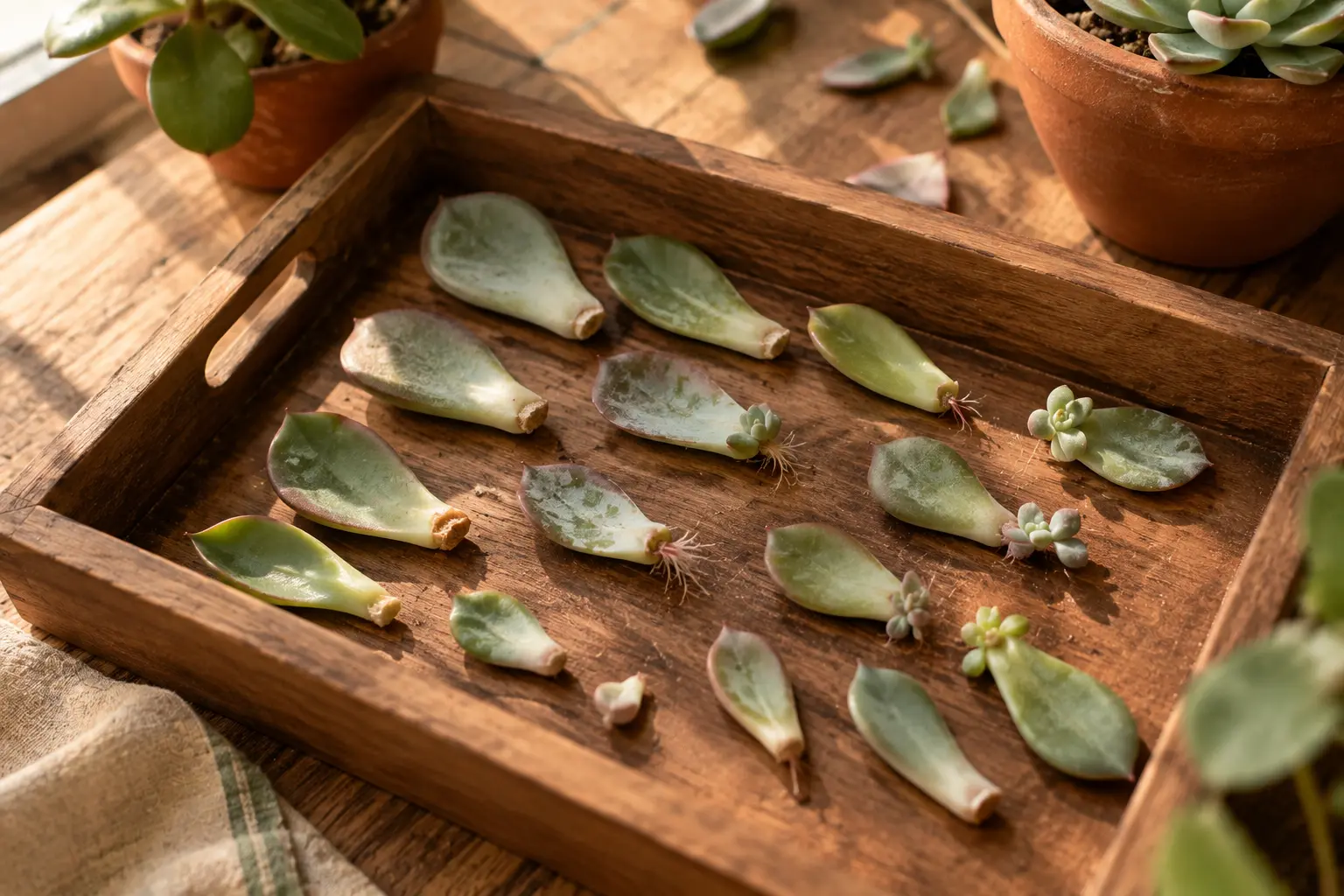
Lay the leaf on a dry tray, cut end up, somewhere bright but out of direct sun. Leave it alone for three to five days. No water, no misting, nothing. The raw end needs to dry into a papery scab first, or it'll rot the moment it touches moist soil.
This is one place Indian conditions genuinely change the advice: in a humid coastal city, callusing can take closer to a week, since the air itself is holding moisture the leaf needs to lose. In a dry, hot city, three days is often plenty — sometimes even less. Don't go by the calendar; go by looking at it. The cut end should look dry and slightly sealed, not fresh and moist, before you move on.

Step 3: Lay It on Soil — Not In Soil
Once callused, place the leaf flat on top of a well-draining soil mix. The calloused end should just touch the surface. Don't bury it, and don't push it in — that's the single most common mistake I see, and it's an easy one to make because it feels like you're "helping" the leaf root faster.
A customer in Bangalore messaged us last year convinced her whole batch was defective — every leaf had gone soft and dark near the base within ten days. Turned out she'd been tucking the calloused tip slightly into the soil each time, thinking it would anchor better. Buried tips trap moisture right against the wound, and that's rot, not rooting. Once she switched to just resting them flat on the surface, the next batch worked fine.
Step 4: The Waiting Game — Weeks Two to Six
Mist the soil lightly every three to four days, just enough to keep it barely damp, never soaked. The leaf has enough stored water to survive on its own for weeks — that's the entire point of a succulent leaf.
Somewhere around week two or three, look closely at the calloused end. Tiny pink or white hair-like roots start showing up first, before any visible new growth. A few weeks after that, a miniature rosette begins forming right at the base of the old leaf — this is the actual new plant. The original leaf will start looking shriveled and sad around this time. That's normal. It's feeding the baby plantlet with whatever water and nutrients it has left.
Resist the urge to tug on the leaf to "check" for roots. You will snap them.
Step 5: Potting Up the Baby Rosette
Wait until the mother leaf has fully shriveled and the new rosette looks like it can stand mostly on its own — usually week eight to ten. Gently separate it (the old leaf often comes away on its own by this point) and pot the baby into its own small container with fresh succulent mix. Skip watering for the first two to three days after transplanting, then treat it like any young succulent — bright indirect light, water only once the soil's fully dry.

The Week-by-Week Timeline at a Glance
| Timeframe | What's happening | What to do |
|---|---|---|
| Day 0 | Leaf twisted off cleanly | Lay flat on a dry tray, cut end up |
| Day 3–7 | Callus forms over the wound | Do nothing — no water, no misting |
| Week 2–3 | First fine roots appear | Move to soil surface, light misting every 3–4 days |
| Week 4–5 | Tiny rosette begins forming | Keep misting lightly, bright indirect light |
| Week 6–8 | Rosette grows, mother leaf shrivels | Reduce handling, let the leaf shrink fully |
| Week 8–10 | Plantlet is independent | Pot up in its own container, skip water for 2–3 days |
Best Time of Year to Propagate Succulents in India
Late September through November works best for most of the country — the same calm, post-monsoon window that's actually the best time to buy succulents in India in the first place, for similar reasons. Stable humidity, mild temperatures, no waterlogged air to slow down callusing.
Peak monsoon is genuinely the worst window — the air's too humid for the leaf to callus properly, and everything left uncovered stays damp longer, which invites rot before roots even get a chance. Peak summer isn't great either, especially in north Indian cities crossing 40°C, since a thin succulent leaf can dry out and shrivel faster than it can root. A cooler, sheltered spot indoors can work then, but it's genuinely harder.
Want to start with leaves that propagate reliably instead of guessing? Our echeveria and jade plant starter picks are chosen specifically because beginners get good results from them.
Which Succulents Actually Propagate Well from Leaves?
Not all of them do, and this is where a lot of generic guides get vague. Echeveria, graptopetalum, sedum, and jade plant (crassula) tend to root reliably from a single leaf. Haworthia, aloe, and most snake-plant-type succulents generally don't — they're built to spread from offsets and division instead, and leaves from these will usually just dry up without rooting. If you're just starting out, pick from the first group; save the trickier species for once you've got a few successful rounds behind you.
Common Mistakes That Stall Leaf Propagation
- Misting too often. Constantly damp soil rots the leaf before it roots — once every 3–4 days is usually enough.
- Skipping the callus stage. Watering a fresh, uncallused wound is close to a guaranteed rot.
- Direct afternoon sun too early. A callusing leaf can scorch; bright indirect light is safer until roots are established.
- Snapping instead of twisting. A torn base rarely roots, no matter how well you care for it afterward.
- Impatience. Digging around to check for roots in week one does more damage than the waiting ever would.
If a leaf shrivels up completely without ever producing roots or a baby rosette, it's not a failure on your part necessarily — some leaves just don't take, even under good conditions. Start with two or three times as many leaves as the number of plants you actually want; that buffer accounts for the ones that won't make it.
Once your propagated babies are ready for their own pots, our range of small terracotta planters is sized right for young succulents — and if anything looks off along the way, our guide on common succulent problems and fixes for Indian homes covers most early-stage issues.
Common questions
A few things people usually ask once they've started a batch.
Do I need rooting hormone to propagate succulent leaves?
No. Succulents root reliably from leaves without any rooting hormone or special powder — the callusing step does the real work of protecting the wound while natural rooting happens on its own.
Why did my succulent leaf shrivel up without growing roots?
Not every leaf successfully propagates, even under good conditions — this is normal and not necessarily something you did wrong. It's more common when the leaf broke away with a torn base instead of a clean twist, or when it was a weaker, older leaf to begin with.
Can I propagate succulent leaves during the Indian monsoon?
It's possible but harder, since high humidity slows down callusing and increases rot risk. If you're attempting it during monsoon months, keep the tray indoors near a fan or in a drier room rather than in an open, humid space.
How often should I mist succulent leaf cuttings?
Roughly once every three to four days is enough for most conditions in India — just enough to keep the soil barely damp. Misting daily is one of the most common reasons leaf propagation fails.
Which succulents are easiest to propagate from a single leaf?
Echeveria, graptopetalum, sedum, and jade plant (Crassula ovata) are generally the most reliable for beginners. Haworthia, aloe, and similar species rarely propagate well from a single leaf and are better started from offsets instead.
When can I start watering a newly potted succulent propagation?
Wait two to three days after potting up the young plantlet before watering, and even then water lightly. A freshly transplanted rosette is still delicate, and overwatering at this stage is a common way to lose a plant you've already spent two months growing.