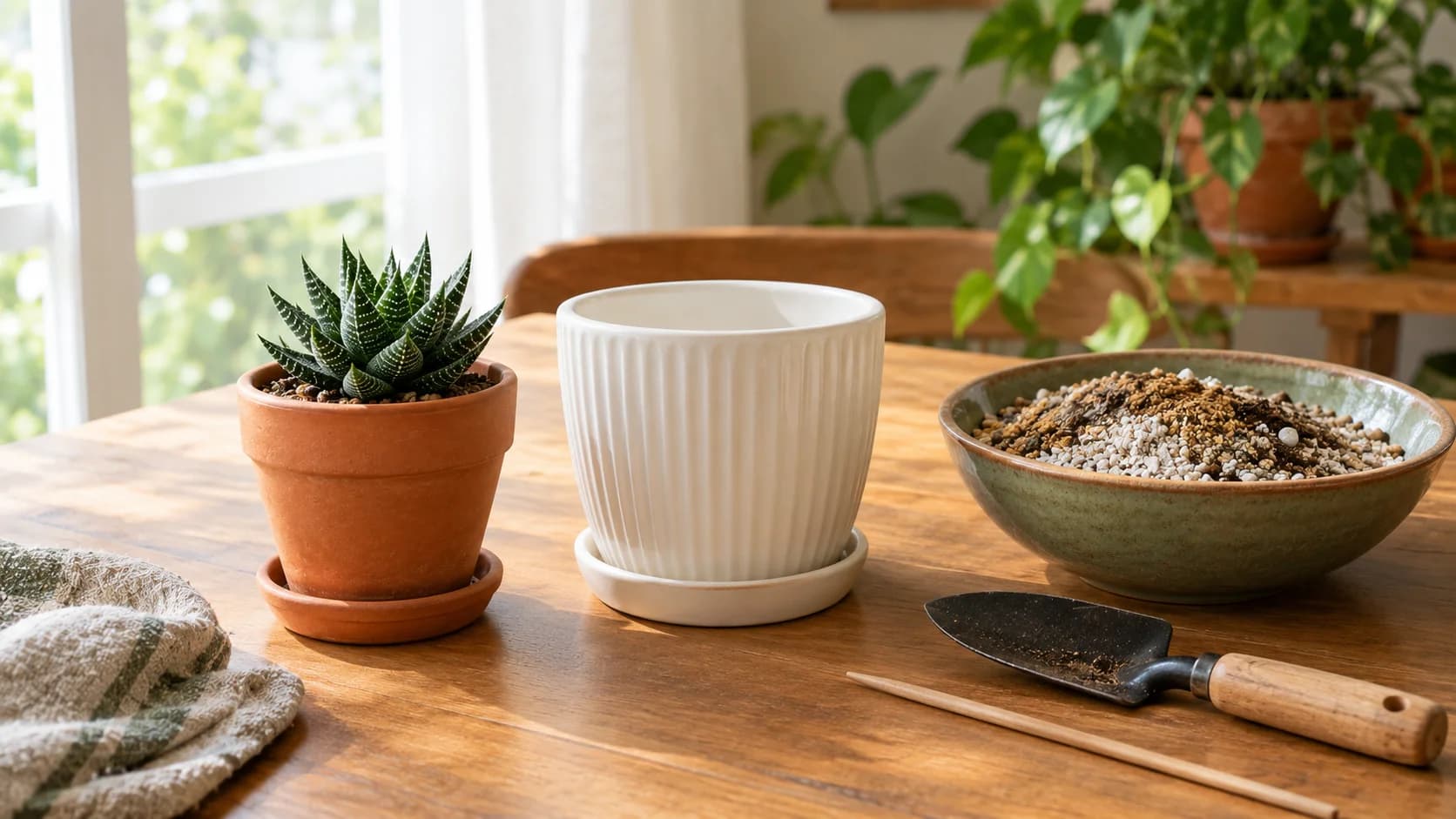
Knowing how to repot a succulent is useful. Knowing when not to is more useful. Succulents grow slowly, and every repotting disturbs the roots, so a plant that's doing fine is usually better left alone.
Yet the internet tells you to repot every year, or the moment you bring a plant home. That advice has killed more healthy succulents than it has saved. The real reasons to repot are about soil and roots, not the calendar.
How often should you repot a succulent?
Most succulents only need repotting every two to three years, or when they clearly outgrow the pot or the soil stays wet. There's no fixed calendar. Slow growers like Haworthia and Gasteria can stay put even longer, while fast-spreading types may need attention sooner.
If you've got a slow, compact plant such as a Zebra Haworthia or a Gasteria, don't be surprised if it's happy in the same pot for years.
How do you know a succulent needs repotting?
| What you see | Repot? |
|---|---|
| Roots poking out of the drainage hole | Usually yes, and move up one size |
| Soil stays wet for well over a week, even in a bright spot | Yes. The soil is the problem, not the pot size |
| Plant is top-heavy and keeps tipping over | Yes, into a heavier or slightly wider pot |
| Bought in dense, dark nursery soil | Yes, once it has settled in for a week or two |
| Soil is hard, shrunk from the pot's edge, and water runs straight through | Yes, it needs fresh mix |
| Pests such as mealybugs in the soil or on the roots | Yes, and clean the roots as you go |
| It's simply been a year | Not by itself |
| Plant looks healthy and new growth is fine | No. Leave it |
That third-from-bottom point trips people up. Picture a succulent picked up from a roadside stall, sitting in a pot of dense, dark soil that never really dries. It might look perfect for a month. Then the lower leaves go soft. The issue isn't the plant. It's what it's rooted in.
When is the best time to repot a succulent in India?
Aim for the cooler, drier months, roughly October to March in much of the plains. Most common succulents, such as Haworthia, Echeveria and Sedum, settle back in fastest when the weather is mild.
Avoid the extremes. In Delhi in May and June, a freshly repotted succulent on a hot balcony gets cooked before its roots recover. In the heavy monsoon months, wet air slows drying and raises the risk of rot. Hill-station timings run differently, so go by your local weather rather than the month name. If the plant is in real trouble, though, repot whenever you have to.
How to repot a succulent step by step
- Let the soil dry out first. Don't water for a few days beforehand. Dry soil falls away easily and the roots are less likely to tear.
- Pick a pot only slightly bigger. Go up by about 1 to 2 cm (roughly half an inch to an inch) in width. A drainage hole is essential. A huge pot holds extra wet soil, which is exactly what you're trying to avoid.
- Prepare a gritty mix. Use a succulent or cactus mix and add coarse sand, perlite or fine gravel, so that roughly half the mix is grit. Plain garden soil or cocopeat alone holds too much water.
- Take the plant out gently. Tip the pot sideways, squeeze the plastic or tap the sides, and ease the plant out. A pencil or chopstick helps to loosen the edges. Wear thick gloves or use folded newspaper for spiky types.
- Shake off the old soil and check the roots. Healthy roots are firm and pale. Black, mushy or foul-smelling roots are rot. Trim them off with clean scissors, right back to firm tissue.
- Let cut roots air-dry. If you trimmed anything, leave the plant in shade for a day or so before potting so the cuts can callus.
- Pot it up. Add a little mix to the bottom of the new pot. Hold the plant so its lowest leaves sit just above the soil level, then pour mix around the roots and tap the pot to settle it. Don't press hard.
- Keep it in bright shade and wait to water. Many growers wait about a week before the first watering. (Yes, it feels wrong to leave a freshly potted plant dry, but the roots need time to heal.) Then return to normal watering, only when the soil is dry.

Which pot should you choose?
Terracotta breathes and dries out faster, which suits most succulents, especially in humid cities. Plastic pots dry more slowly, so water less often. Whatever you pick, look for a drainage hole.
Ceramic pots look lovely for a shelf or desk. This textured matt ceramic planter in beige and this white cylindrical pot set with a geometric design are compact enough for small succulents. Check for a drainage hole before you plant directly into any decorative pot. If there isn't one, keep the succulent in a plain nursery pot and slip it inside the ceramic one as a cover, lifting it out to water.
What if your succulent arrived bare rooted?
Some plants are shipped without a pot of soil around the roots. Several of our listings, such as the Zebra Haworthia, mention delivery bare rooted. That's normal and it makes shipping safer. It also means the plant needs potting soon after it arrives.
Pot it in a gritty mix as described above, keep it in bright shade, and go easy on the first watering. Our guide on what to do when your succulents arrive walks through the first few days in more detail.

What should you never do when repotting a succulent?
- Don't jump to a much bigger pot. Extra soil means extra moisture.
- Don't use a pot with no drainage hole, or heavy garden soil on its own.
- Don't water straight away. Give the roots a few days to settle.
- Don't repot during peak summer heat or in the wettest monsoon weeks unless it's an emergency.
- Don't put a freshly repotted plant straight into hard afternoon sun.
- Don't pack the soil down hard. Roots need air.
- Don't repot a healthy plant just because a blog said "once a year".
If the plant looks sick after a repot, read our guide on why succulents die and how to fix each problem. And for watering, light and soil in general, see the complete succulent care guide for India.
Repotting a leggy or overgrown plant often leaves you with cuttings. You can turn them into new plants with our week-by-week guide to propagating succulents from leaves.
Repotting succulents: frequently asked questions
Should I repot a succulent right after buying it?
Not always. If the soil is dense and stays soggy, or the plant arrived bare rooted, repot fairly soon. If it looks healthy in reasonable soil, let it settle for a week or two first.
Can I repot a succulent while it's flowering?
You can, but it adds stress. If the plant is healthy, wait until the flowers fade. If the roots are rotting, don't wait.
How long should I wait to water after repotting?
Many growers wait about a week, so any damaged roots can heal. If the plant looks very dehydrated, water lightly after a few days instead.
What is the best soil for repotting succulents?
A well-draining mix. Use cactus or succulent mix and add coarse sand, perlite or fine gravel so that about half is grit. Avoid using plain garden soil or cocopeat alone.
Which pot is best for succulents?
Any pot with a drainage hole. Terracotta dries faster and suits most succulents, especially in humid cities. Choose one only slightly wider than the roots.
Do succulents like being root bound?
Many tolerate a snug pot well, and some even prefer it. A tight pot is only a problem if roots are circling heavily, the soil stays wet, or the plant is tipping over.
Got a plant that needs a fresh start? Browse the full succulent collection or make your own set with the custom combo builder, and pot them up in something with a drainage hole.
Author Name: Succulent Sphere Team