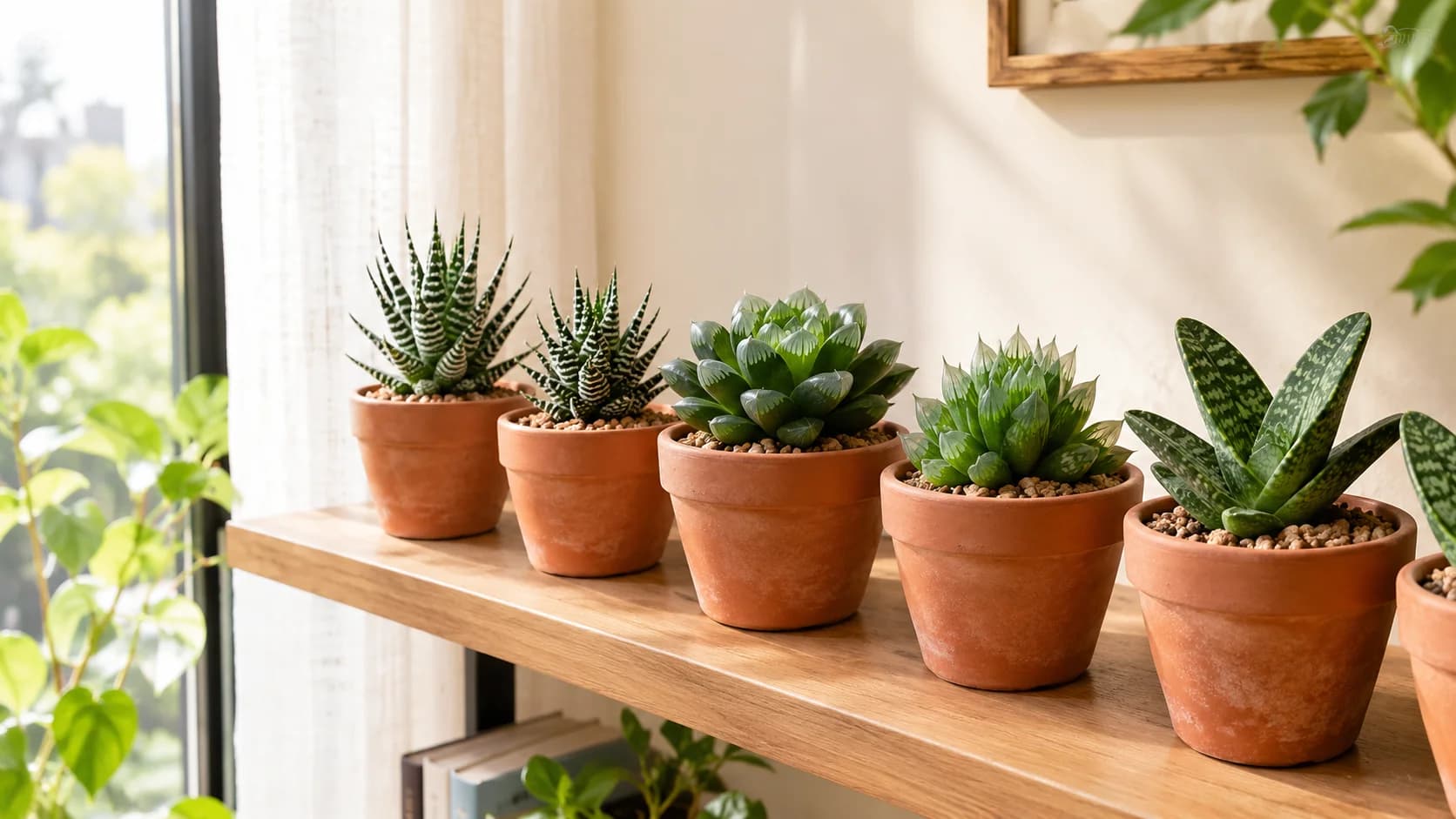
You got a cute succulent as a gift, and the only spot free in your flat is a shelf in the living room, three metres from the nearest window. So: can succulents survive indoors without sunlight? Sort of. Mostly no. And the "sort of" depends entirely on which succulent you own.
This is one of the most common ways succulents get killed in city flats, Bangalore's grey, overcast weeks included. The plant isn't hard to keep alive. It's just been put in the wrong place and then watered as if nothing was wrong.
Can succulents survive indoors without sunlight?
No succulent survives for long in complete darkness, because every plant needs some light to make food. A few, like Haworthia and Gasteria, cope with bright indirect light or a few hours of gentle sun. In a windowless room, they'll slowly weaken unless you add a grow light.
So the honest answer has two halves. "Without direct sunlight" is fine for some succulents. "Without light" is not fine for any of them. Most "low light succulent" advice quietly blurs those two things together, and that's where the confusion starts.
What does "low light" actually mean for a succulent?
It doesn't mean dim. It means bright but indirect. Think of a spot near a window where the sun's rays never land on the leaves, yet the room is clearly bright during the day.
Here's a rough way to judge a spot. Hold your hand about a foot above the plant around midday. A sharp shadow means it's bright. A soft, blurry shadow means medium light. If you can barely see a shadow at all, it's too dark for any succulent to do well long term. It's a rule of thumb, not a lab test.
| Spot in your home | What it means for succulents |
|---|---|
| Window with direct sun for a few hours | Fine for nearly all succulents, though harsh west sun in summer can scorch |
| Next to a bright window, but no direct sun lands on it | Good for Haworthia, Gasteria and some aloes |
| A few feet inside a bright room | Survival only. Growth slows and colour fades |
| Corner, hallway or bathroom with no window | Not workable without a grow light |
As a general guide in India, an east-facing window gives gentle morning light and is often the easiest place for these plants. North-facing windows are softer and dimmer. West-facing ones can get hot and harsh in the afternoon.

Which succulents handle low light best?
These are the ones I'd start with. None of them love a dark room, but they forgive a lot more than the sun-loving types.
- Haworthia. The most reliable choice. Try the striped Zebra Haworthia, the see-through leaves of Cathedral Window Haworthia, Haworthia Cymbiformis Pallida or the soft-leaved Haworthia Herbacea.
- Gasteria. Thick, tongue-shaped leaves and an easygoing nature. See our Gasteria. Its hybrid Gasteraloe Limpopo is another tough option.
- Lace Aloe. A compact aloe that tolerates lower light than the big aloes. Have a look at Lace Aloe.
You'll also see snake plants and ZZ plants recommended for dark corners. They are tougher in dim rooms, and they store water like succulents do. But they're a different group of plants, so I'm keeping this list to true succulents. If a place is truly dark, a snake plant will do better than any of the above.
Not sure where to start? The beginner-friendly collection is a safe place to browse, and most of the Haworthia and Gasteria options above sit at around ₹80 to ₹100 at the time of writing.
Which succulents will struggle in a dim room?
This is where most buyers go wrong. The plants that look most like "succulents" in photos are usually the ones that need the most sun.
- Echeveria, such as Echeveria Elegans. In low light it stretches upward and loses its tight rosette.
- Sempervivum, sold in India as Laxmi Kamal. It wants real sun.
- Sedum, like Sedum Nussbaumerianum. Sparse, leggy growth is the usual result in shade.
- Jade plants. They can sit in a bright indoor spot, but they really prefer a sunny window.

How do you care for succulents in low light?
Here's the part most guides leave out. Less light means slower growth, and slower growth means the plant uses far less water. The mistake isn't the dark corner itself. It's watering a slow-growing plant on a summer schedule.
- Place the plant as close to a bright window as you can, even if the sun never hits it.
- Push a finger or a wooden skewer deep into the soil. Water only when it's completely dry all the way down.
- Expect to water far less often than your outdoor plants. Indoors in low light it might be once every two to four weeks, and less in cool or damp weather.
- Use a gritty succulent mix and a pot with a drainage hole. Wet soil in a dim room dries painfully slowly.
- Turn the pot a quarter turn every week or two so the plant grows evenly.
- Dust the leaves lightly. Dusty leaves catch less of the little light there is.
Air-conditioned rooms make this trickier. They're cooler, often drier, and the light is usually weak too, so the soil stays wet longer than you'd think. Check the pot before you water.
What if the room has no window at all?
Then you need a grow light. Ordinary room bulbs and tube lights are too weak for most plants, so pick a full-spectrum LED grow light made for plants. Position it fairly close to the plant and run it for several hours a day, following the maker's instructions. Switch it off at night so the plant gets a normal day and night.
Even with a grow light, stick to the low-light varieties above. Sun-lovers like Echeveria won't look their best under artificial light.
What should you never do to a succulent in low light?
- Don't water on a fixed weekly routine. Dry soil is your signal, not the calendar.
- Don't put a sun-loving succulent in a dark room and hope it adapts.
- Don't move a plant from deep shade straight into hard afternoon sun. Leaves burn (gradual moves only).
- Don't use a decorative pot with no drainage hole.
- Don't fertilise a plant that isn't growing.
How do you know your succulent isn't getting enough light?
- It stretches toward the window, with wide gaps between leaves.
- Colour fades to a pale green and the leaves look thin.
- Growth stops for months, while the soil stays damp.
- Lower leaves turn mushy or drop.
If you spot these, move the plant closer to light first. If leaves have gone soft and translucent, it may be rot, so read our guide on why succulents die and how to fix each problem, and the complete succulent care guide for India for the fundamentals.
Frequently asked questions
Can succulents live in a room without windows?
Not for long without help. Without a window they need a full-spectrum grow light. Without either, they will slowly stretch, fade and decline.
Can succulents grow under tube lights or LED bulbs?
Household tube lights and bulbs are usually too weak. A plant-specific full-spectrum LED grow light works far better, and you should place it close to the plant.
What is the best succulent for a dark room?
Among true succulents, Haworthia and Gasteria are the usual first picks, as long as the room is bright enough to read in without switching on a lamp. In a truly dark room, none will thrive.
How long can a succulent go without sunlight?
It depends on the plant and the room. Tougher ones may hang on for weeks or a few months while getting weaker. Sun-loving types decline faster. Move it toward light rather than testing its limits.
Are snake plants and ZZ plants succulents?
They store water and are often called succulents in casual talk, but they're different plants from Haworthia or Echeveria. They tolerate dim rooms better than most true succulents.
Do low-light succulents need less water?
Yes. Low light slows growth, so the plant uses water slowly. Water only when the soil has dried completely, and expect longer gaps than for a sunny outdoor plant.
Ready to bring one home? Browse the full succulent collection, or put together a set of low-light plants with the custom combo builder. And put them near the brightest window you have.
Author Name: Succulent Sphere Team